Industrial conveying systems are no longer simple belts moving boxes between fixed points. They now connect production, storage, inspection, packaging, and shipping. A small misalignment can create product damage, noise, dust, and hours of unplanned downtime. In 2026, manufacturers will need more than higher belt speeds. They will need measurable flow, safer maintenance, and better energy control.
The MHI 2024 Annual Industry Report shows that supply chain organizations are increasing investment in automation and digital technologies. Its findings also highlight continuing pressure from labor shortages and service expectations. MarketsandMarkets’ Conveyor System Market research identifies automation, modular designs, and smart monitoring as major growth drivers. These trends support a practical question: how to optimize industrial conveying systems without replacing every machine? The answer usually begins with a site audit. Measure cycle time, accumulation points, motor load, transfer gaps, and restart frequency. Watch the line during peak production. The quiet shift can reveal problems.
Energy deserves close attention. The U.S. Department of Energy recommends evaluating motor, drive, and control performance as a complete system. A variable-frequency drive may reduce waste, but only when properly sized and programmed. Oversized motors still consume resources. Poorly tensioned belts still slip. These details matter.
Reliable optimization also requires evidence. Compare baseline data with results after each change. Use vibration readings near bearings. Check belt tracking after cleaning. Review alarms, not just production totals. Some recommendations will fail in a real plant. That is normal. Operators may notice constraints that dashboards miss. Their experience should challenge the engineering plan, not decorate it. The best 2026 strategy is disciplined, practical, and open to correction.
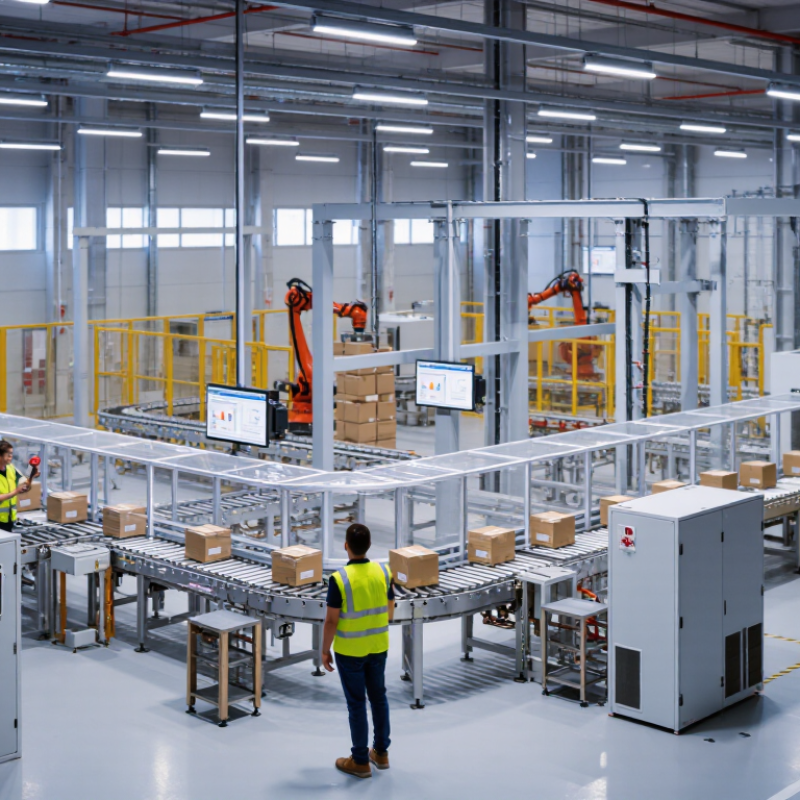
Industrial conveying systems move materials through controlled, repeatable paths. Their performance depends on coordinated components, not speed alone. A typical line includes a frame, drive motor, gearbox, belt or rollers, pulleys, bearings, sensors, and guarding. The drive creates torque. Pulleys transfer that force. The belt carries the load, while tension keeps movement stable. Sensors monitor position, accumulation, and misalignment. In practice, small alignment errors can cause major tracking problems. I have seen a clean belt fail early because materials entered unevenly. Design assumptions require real testing.
The operating principle is simple but highly sensitive. Materials are loaded, accelerated, transported, and discharged. Friction, belt tension, incline angle, load weight, and speed affect energy use and throughput. Engineers should calculate peak loads, not only average loads. Variable-speed control can reduce product damage and unnecessary power consumption. However, faster movement may increase spillage and stopping distance. That trade-off is easy to underestimate. Regular inspections should examine pulley surfaces, bearing temperature, belt wear, and sensor accuracy. Maintenance records also reveal repeating faults that visual checks may miss.
Tips: Keep loading centered and consistent. Check belt tension weekly. Clean transfer points before buildup hardens. Record unusual noise, vibration, and temperature changes. Test emergency stopping functions under controlled conditions. Review the data monthly, but do not trust automation blindly. A technician’s observation can expose a problem before the dashboard does.
Common parts include a frame, drive motor, gearbox, belt, rollers, pulleys, bearings, sensors, and guards. Each part supports stable material movement.
The drive motor creates torque. Pulleys transfer that force to the belt or rollers. The belt carries materials along a controlled route.
Load weight, belt speed, incline angle, friction, material density, and moisture all affect performance. Peak loads matter more than average loads.
Map every pickup, transfer, inspection, and discharge point first. Keep routes short and straight when practical. Leave working space around drives and tensioning areas.
Centered loading reduces tracking problems, spillage, and unnecessary power use. Uneven feeding can damage a clean belt surprisingly quickly.
Match motor output to actual demand. Use variable-speed control when flow changes. Keep bearings clean, belts aligned, and tension correctly adjusted.
Check pulley surfaces, bearing temperature, belt wear, alignment, sensor accuracy, unusual noise, vibration, and temperature changes. Small clues can reveal larger faults.
Use measured flow rates, product density, particle size, moisture, operating hours, and peak surges. Add a realistic margin for expansion.
Not completely. Sensors may miss developing mechanical problems. A technician can notice vibration, smell, or unusual belt movement before a dashboard reacts.
Run a timed trial with a loaded belt. Test stopping functions in controlled conditions. Compare actual throughput, energy use, spillage, and rejected material. A spreadsheet can be wrong.
Optimizing industrial conveying systems begins with understanding how core components work together, including conveyors, drives, belts, rollers, chutes, sensors, and control units. A successful design considers material characteristics such as size, weight, moisture, abrasiveness, temperature, and flow behavior, along with required throughput, travel distance, elevation changes, and operating conditions. These factors help determine whether belt, roller, screw, chain, pneumatic, or other conveyor types are most suitable for each application.
The next step is to optimize the system layout for smooth material flow, minimal transfer points, appropriate capacity, and reduced energy consumption. Proper sizing, efficient motor control, balanced loading, and well-planned routing can improve productivity while lowering operating costs. Smart monitoring systems can track performance, detect abnormal conditions, and support timely adjustments. Finally, effective guarding, emergency controls, operator training, regular inspections, lubrication, alignment checks, and preventive maintenance are essential. Together, these practices provide a practical framework for how to optimize industrial conveying systems safely, reliably, and efficiently.

 Trakkx Tech