In 2026, material handling efficiency will depend less on isolated equipment upgrades and more on disciplined, measurable workflows. Warehouses are facing tighter delivery windows, higher labor costs, and growing SKU variety. A faster conveyor cannot repair a poor layout. It may only move mistakes more quickly.
Taiichi Ohno, the Toyota engineer who shaped lean manufacturing, said, “Without standards, there can be no kaizen.” This principle remains highly relevant to how to improve material handling efficiency. Teams should document travel paths, picking methods, replenishment rules, and safety checks before changing them. Measure walking distance, dock-to-stock time, picking accuracy, equipment idle time, and damaged cartons. A simple stopwatch study near the receiving dock can reveal more than a polished dashboard.
Small details matter. Store fast-moving cartons between knee and shoulder height. Mark pedestrian lanes clearly. Position scanners where operators naturally reach. Review empty pallet locations during every shift. These changes can reduce wasted motion without expensive automation.
Still, no single formula fits every operation. A layout that works for a compact e-commerce site may fail in a cold-storage facility. Automation can also create new bottlenecks when data is inaccurate or staff lack training. That is where many improvement plans become too confident.
The most reliable approach combines employee experience, process data, equipment expertise, and regular review. Test one change. Observe the result. Correct the weak parts. Then standardize what genuinely works. Efficiency is not merely speed; it is safer movement, fewer errors, better space use, and dependable customer service. Progress can be uneven. That is normal.
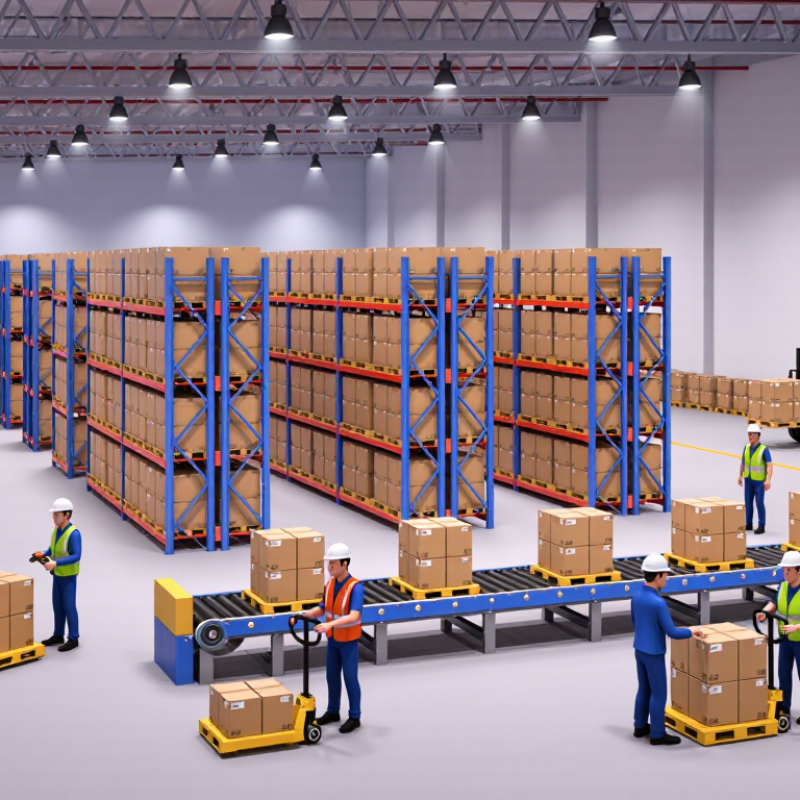
2026 Top Tips to Improve Material Handling Efficiency
Understanding Material Handling Efficiency and Its Core Principles
Material handling efficiency means moving, storing, and protecting goods with minimal time, distance, damage, and labor. It begins with flow, not equipment. Map one pallet from receiving dock to shipping lane. Record every wait, lift, turn, and manual entry. Small delays often hide between processes.
The Material Handling Institute’s 2024 industry report found that 55% of respondents planned to increase technology and innovation investment. That investment should follow measured problems, not fashionable tools. A warehouse may need better slotting before automation. Place fast-moving cartons near dispatch, keep heavy loads between knee and shoulder height, and maintain clear travel paths. Ergonomic design reduces unnecessary reaching and twisting. The International Labour Organization reports that work-related musculoskeletal conditions remain a major occupational health concern worldwide.
Standardization supports reliable performance. Use consistent pallet locations, readable labels, and simple scanning rules. Track travel time, order accuracy, damage rates, and near misses weekly. The U.S. Bureau of Labor Statistics reported 2.6 million nonfatal workplace injuries and illnesses in private industry during 2023, showing why speed cannot replace safe methods.
People still matter.
Operators notice blocked aisles, unstable loads, and awkward handoffs before dashboards do. Ask them to test layout changes during a normal shift. Some measurements will conflict. That is useful. A shorter route may increase congestion, while a faster machine may create more inspection work. Review the evidence before changing the entire system.
| Efficiency Dimension | Key Principle | Baseline Value | 2026 Target | Expected Improvement | Top Improvement Tip | Recommended Measure |
|---|---|---|---|---|---|---|
| Order-Picking Travel Time | Minimize unnecessary movement | 18.0 minutes per order | 13.5 minutes per order | 25.0% reduction | Use ABC slotting and place high-frequency items close to dispatch or replenishment points. | Average picker travel time per completed order |
| Picking Accuracy | Build quality into the process | 97.5% | 99.0% | +1.5 percentage points | Combine barcode scanning, location verification, and exception checks before packing. | Correct order lines ÷ total order lines × 100 |
| Dock-to-Stock Cycle Time | Create a continuous material flow | 90 minutes | 60 minutes | 33.3% reduction | Pre-assign receiving locations and use advance shipment information to prepare labor and space. | Time from vehicle arrival to inventory availability |
| Material-Handling Equipment Utilization | Match capacity to demand | 65% productive utilization | 75% productive utilization | 15.4% relative increase | Schedule equipment by workload, reduce idle time, and monitor congestion at shared travel paths. | Productive operating time ÷ available scheduled time × 100 |
| Empty Travel | Eliminate non-value-added activity | 35% of equipment travel | 22% of equipment travel | 37.1% reduction | Coordinate put-away and retrieval tasks so return trips carry a load whenever safe and practical. | Empty travel distance ÷ total travel distance × 100 |
| Material Damage Rate | Protect people, products, and equipment | 1.8% of handled units | 1.0% of handled units | 44.4% reduction | Standardize load securing, handling instructions, equipment inspections, and operator training. | Damaged units ÷ total handled units × 100 |
| Throughput | Increase flow without sacrificing quality | 100 order lines per labor hour | 125 order lines per labor hour | 25.0% increase | Balance workloads across zones and remove bottlenecks before adding labor or equipment. | Completed order lines ÷ direct material-handling labor hours |
| Inventory Location Accuracy | Maintain reliable information and visibility | 96.0% | 99.0% | +3.0 percentage points | Require scan confirmation for receiving, movement, replenishment, picking, and cycle counting. | Correctly located inventory records ÷ audited records × 100 |
| Order Cycle Time | Synchronize people, processes, and technology | 150 minutes | 105 minutes | 30.0% reduction | Use time-stamped workflow data to identify waiting, batching, handoff, and replenishment delays. | Elapsed time from order release to shipment-ready status |
Walk the material route during a normal shift. Record travel distance, waiting time, load changes, and repeated handling. Watch actual movement, not an ideal diagram. A short, approved video may reveal hidden pauses. Ask operators where congestion feels predictable.
Mark narrow aisles, blind corners, uneven floors, poor lighting, and traffic-facing doors. Measure queue lengths at different hours. Shift changes can alter the entire route. Small details matter.
Compare waiting points, handoffs, travel times, and equipment performance. If workers wait beside a loading point, more speed may increase risk. Try a small layout change first. Measure several shifts before approving major spending. The first explanation may be wrong.
Match equipment to load weight, aisle width, floor condition, and travel distance. Check turning space with a full load. Review battery access, controls, capacity, and maintenance records. Do not judge equipment by age alone. An older unit may still perform reliably.
A warehouse management system can connect orders, inventory, labor, and equipment availability. Barcode or RFID scanning can improve receiving, picking, and dispatch visibility. Sensors may identify collisions, overloads, or delays. Data helps reduce empty travel. But data can be incomplete.
They suit repeatable routes and predictable loads. Trained operators should manage unusual loads and exceptions. Check aisle width, floor conditions, traffic patterns, and handoff points first. A sophisticated machine can fail in a narrow aisle. Pilot one process.
Test one process before changing the entire facility. Measure travel time, damage rates, near misses, energy use, and order accuracy. Continue measurements for several weeks. Review results with operators after real shifts. Computer simulations are not enough.
Software updates, sensor faults, network gaps, and awkward controls can interrupt work. Training should include manual fallback procedures. Teams should record what changed and what failed. I have sometimes focused on visible bottlenecks and missed hidden delays. That mistake still teaches something.
Improving material handling efficiency begins with understanding how materials, people, equipment, and information move through a workplace. The first step is to assess current workflows, identify delays, reduce unnecessary movement, and recognize workplace constraints such as limited space, poor visibility, or uneven workloads. This evaluation helps organizations choose suitable technologies and equipment that support safer, faster, and more accurate material movement without adding unnecessary complexity.
A well-planned warehouse layout can shorten travel distances, improve inventory flow, and make frequently used items easier to access. Clear communication and coordinated employee responsibilities are equally important for maintaining smooth operations. To understand how to improve material handling efficiency over time, teams should track practical measures such as processing speed, handling errors, equipment use, space utilization, and workplace safety. Regular reviews allow organizations to refine procedures, respond to changing demands, and build a more reliable and productive handling system.

 Trakkx Tech