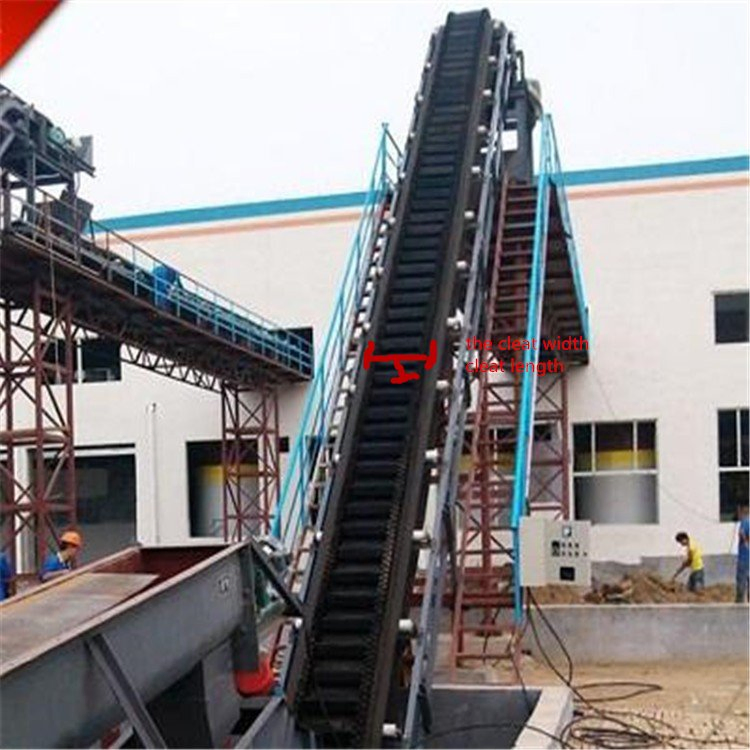
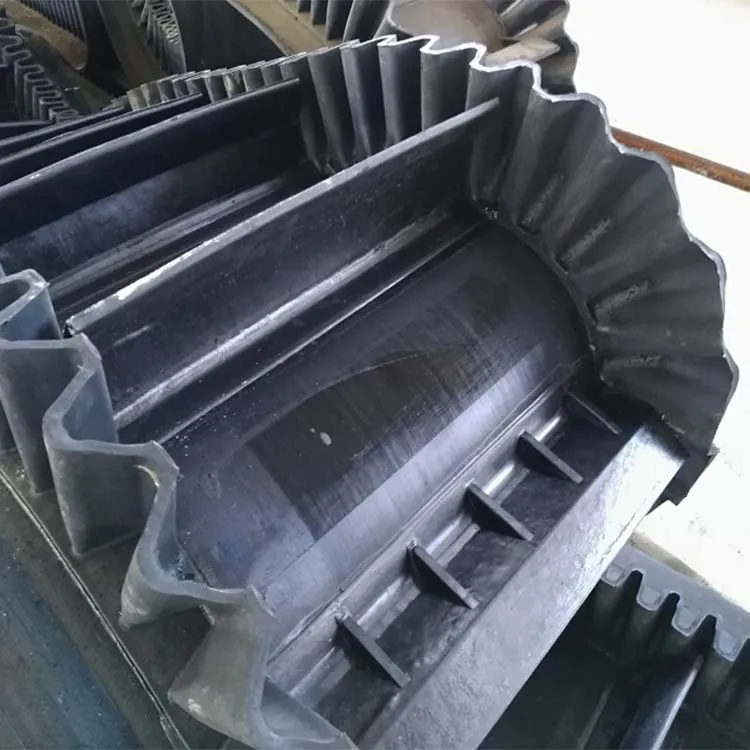
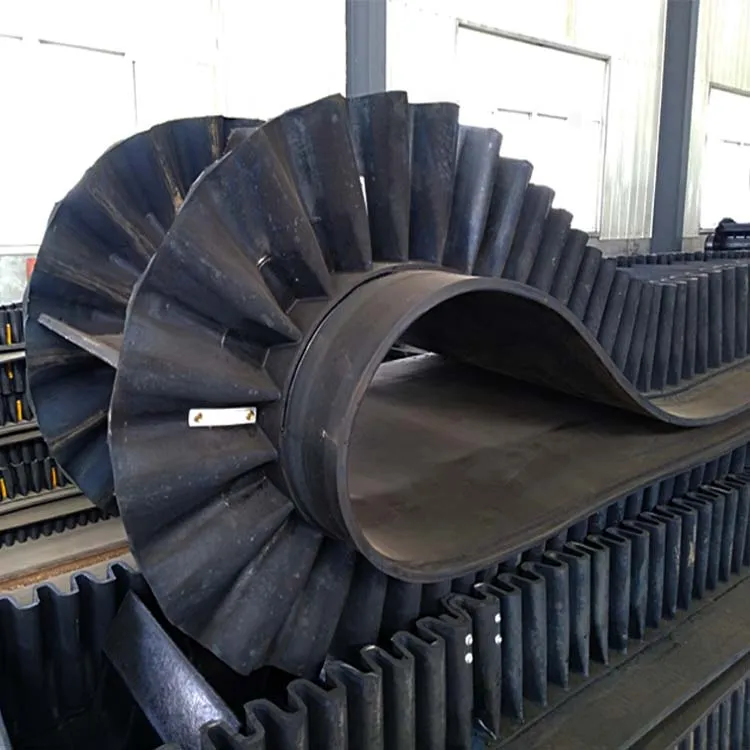
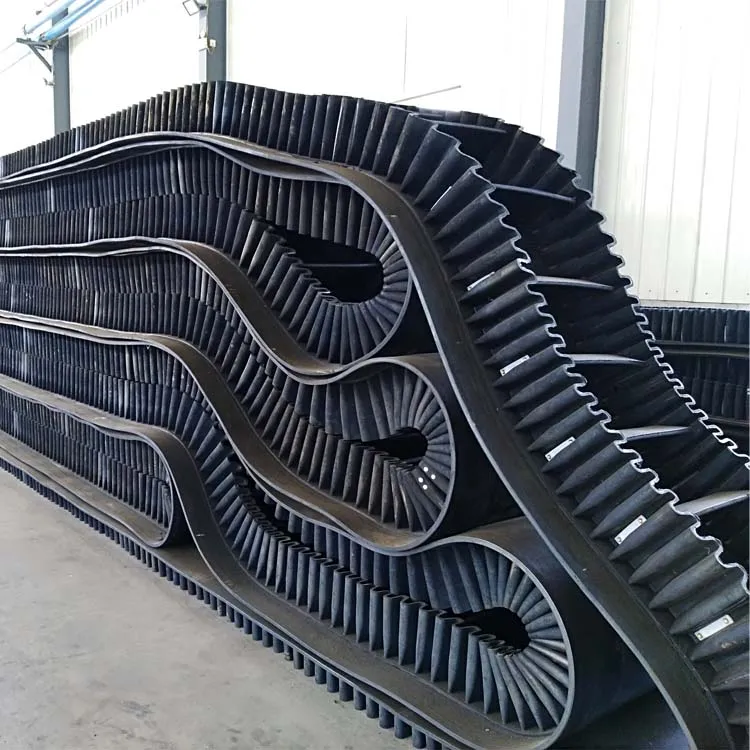
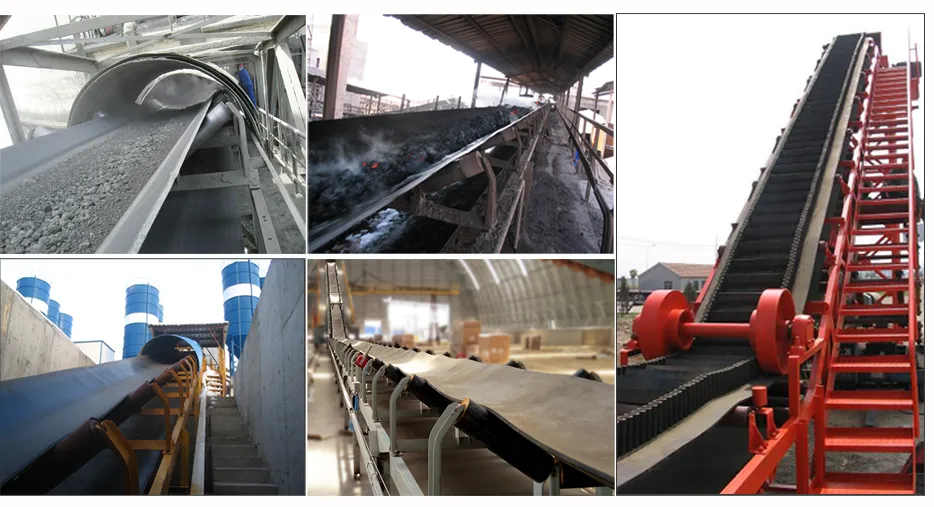
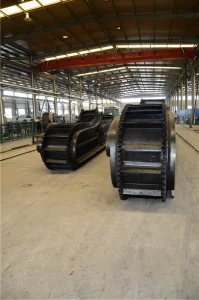
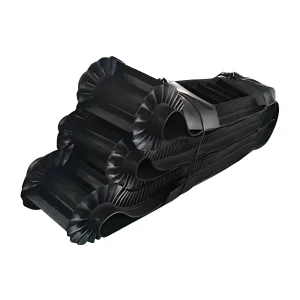
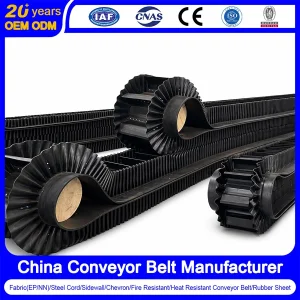
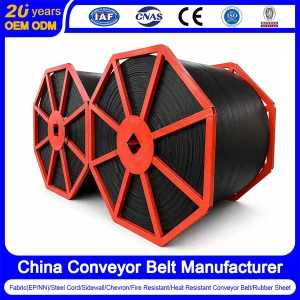
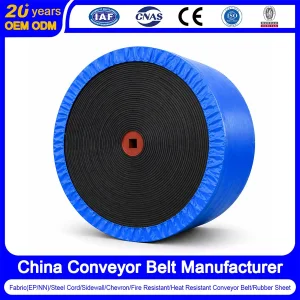
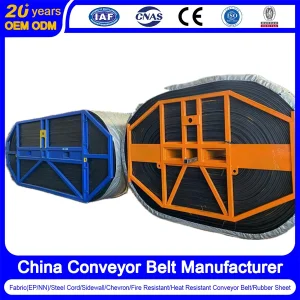
Sidewall conveyor belt consists of base belt, sidewalls and cleats. There are usually transverse steel wire reinforcement inside top & bottom covers of the base belt.
Cleat types: TC - The cleat is made of enforced fabric, solid, anti-shock to avoid distortion. "TC" normally used from 0 degree to 90.
3. Standard
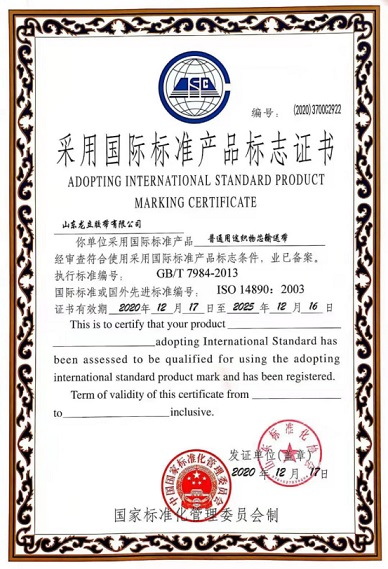
GB/T7984, HG/T4602, DIN22102, BS490, AS1332, RMA, JISK6322, SABS1173 etc.
Application
Corrugated Sidewall Conveyor Belt (Steep angle sidewall conveyor belts) is normally used to bulk materials at inclines of up to 90 degree in fields of construction industry, salt mining, stones and earth, fertilizer, chemical industry, recycling industry, agriculture.
It also used together with belt conveyor for horizontal & short-distance transportation. (no cleats the moment)
Feature 1
High efficiency
Feature 2
Stuff with large obliquities
Feature 3
Largest angle is ninety degree
Feature 4
Low maintain cost
Feature 5
Easy operation
Detailed Product Description
Applying for large angle transporting, the maximum angle is 90 degree / 90°.
Characteristics
1. To save time: Because of large angle transporting, thus can be shortened the horizontal length and save the space of laying area.
2. Strong transporting capacity: Compared with common conveyor belt, with large carrying cross section, has stronger transporting capacity than same width conveyor belt.
3. Without sidewall plate: Because without sidewall plate, thus avoid the local abrasion.
4. Impossible to use small roller: Impossible to use the traditional size of small roller.
5. Reinforced core: Because the baseband uses special canvas core to improve the canvas, then improve the anti-broken ability of belt at the same time.
6. Heat vulcanization: The sidewall plate and diaphragm are adhesive with baseband through heat vulcanization method, thus ensure the bonding strength.
Baseband
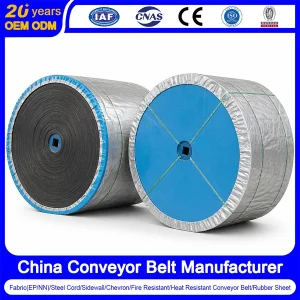
Baseband is consisted of upper rubber, lower rubber, core and transverse rigid layer. Upper rubber thickness is 3-6mm, the lower rubber thickness is 1.5-4.5mm. The core supports tensile force, the core are: Cotton(CC), Nylon, EP. To improve the transverse rigid ability, it has added special reinforced layers in the core, named transverse rigid layer. Baseband has the same width with common belt.
Cleat
The cleat is produced by fiber load materials. With large anti-shock ability and impact resistance, thus avoid the distortion of stress. The cleat has T, TS, C, TC, TCS five types. TS and TCS types are mosaic pattern. The conveyor angle is small than 40°, using T or TS cleat; the conveyor angle is bigger than 40°, using C, TC or TCS cleat.
Corrugated sidewall plate
According to the carrying capacity, there are three types corrugated sidewall: Light type(N), Medium type(S), Heavy type(ES).
Frequently Asked Questions (FAQ)
What components make up the structure of a sidewall conveyor belt?
A sidewall conveyor belt consists of a base belt (baseband), sidewalls, and cleats. The baseband typically features transverse steel wire reinforcement inside both the top and bottom covers to enhance stability.
What is the maximum transporting angle for this conveyor belt?
The corrugated sidewall conveyor belt is designed for steep and large angle transporting, supporting material transport up at an incline of up to 90 degrees.
How do I choose the correct type of cleat for different angles?
The selection depends on the conveying angle: for angles less than 40°, T or TS cleats are recommended. For angles greater than 40°, C, TC, or TCS cleats are used to ensure secure transport and prevent material rollback.
What standards do these sidewall conveyor belts meet?
These conveyor belts conform to multiple domestic and international standards, including GB/T7984, HG/T4602, DIN22102, BS490, AS1332, RMA, JISK6322, and SABS1173.
What are the three types of corrugated sidewall plates?
Based on the required carrying capacity, the corrugated sidewall plates are categorized into three distinct types: Light type (N), Medium type (S), and Heavy type (ES).
What materials are used for the baseband core?
The core of the baseband, which supports the overall tensile force, is made of Cotton (CC), Nylon, or EP. Special transverse rigid layers are integrated into the core to enhance anti-broken and transverse rigid abilities.
 Trakkx Tech